
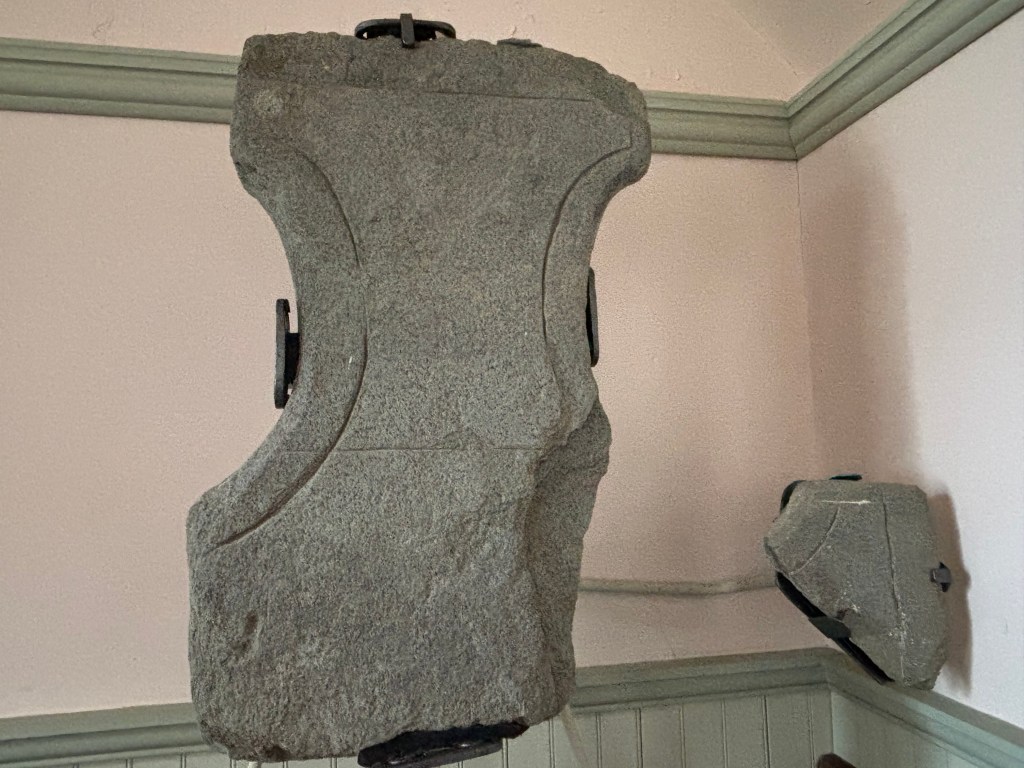
Fragments of this remarkable free-standing stone cross were discovered in Inchnadamph churchyard in 1993, where they had been reused as a grave marker.

When complete, the cross is thought to have stood about three metres tall. It has been dated broadly to between the 8th and 11th centuries, making it by far the most northerly known cross of its kind on the Scottish mainland.
The cross was carved from a grey-green metabasic rock originating in the south-west Highlands—an area well known for its carved crosses. We do not know whether the stone was brought to Inchnadamph as an unworked block and carved locally, or whether the finished cross was transported here. Either journey would have required considerable effort.
Its overall shape has similarities with crosses from the south-west, including the Kilnave Cross on Islay. Its decoration, however, is much more unusual: a simple chamfer and incised border which has no known parallel in the Highlands. This distinctive style may reflect Scandinavian or Anglo-Scandinavian influence.
The cross probably marked a sacred place used for outdoor worship, with a simple church later built nearby. A roughly circular enclosure survives in low-lying ground a few metres south-west of the churchyard. It may be prehistoric in origin, although places like this were sometimes reused by early Christian missionaries.
These surviving fragments take the story of worship at Inchnadamph back many centuries before the present church—and leave us with some fascinating unanswered questions. Who commissioned and carved the cross? Was it made locally or carried into Assynt? And what did Inchnadamph mean to the people who gathered beneath it more than a thousand years ago?