Tag: Ardvreck

  • FROM THE ARCHIVE: ASSYNT GOLF CLUB TROPHIES

    In an earlier post, we explored the story of the nine-hole golf course laid out by Eric Chaplin around Eadar a’ Chalda, Ardvreck Castle and Calda House in the early twentieth century.

    These two surviving trophies add another fascinating piece to the story of golf in Assynt.

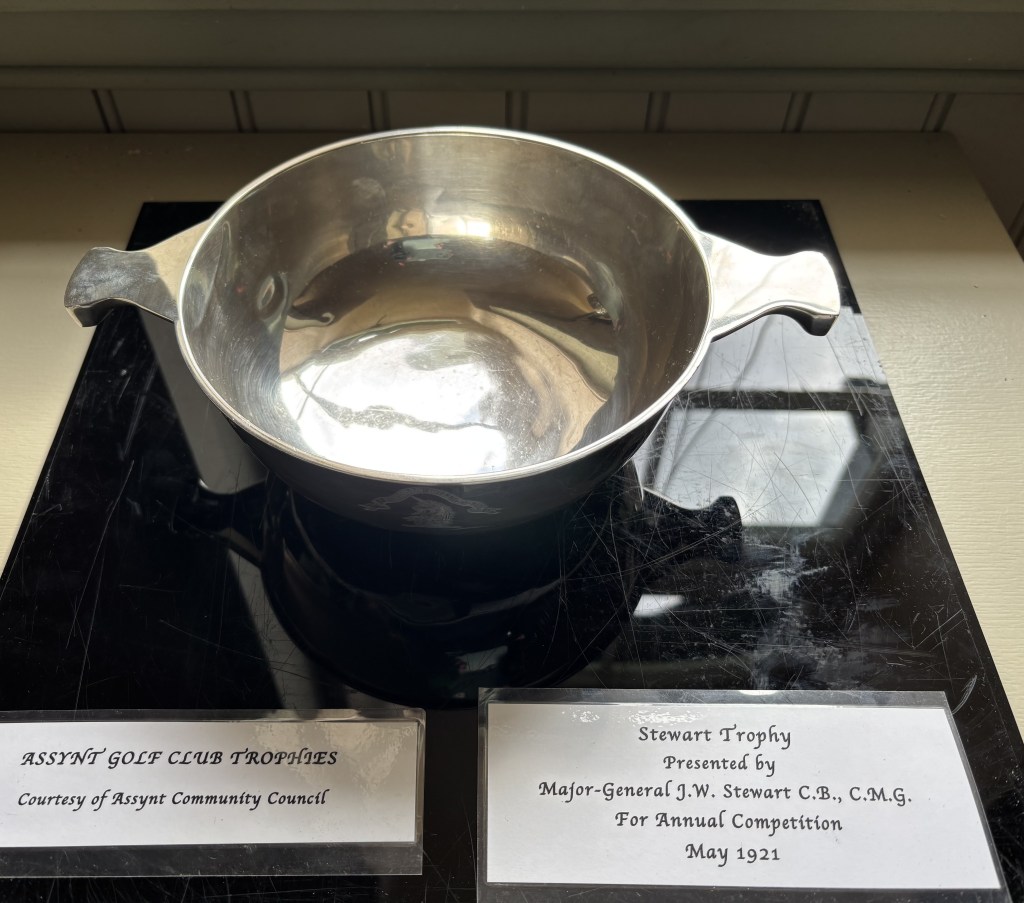
    The silver bowl is the Stewart Trophy, presented to Assynt Golf Club by Major-General J. W. Stewart, C.B., C.M.G., for an annual competition in May 1921.

    The second, more ornate cup was presented by Sir R. L. Harmsworth MP in the same year. Its recorded winners were:

    • 1921 – Captain J. Munro, M.C.
    • 1922 – J. R. Skinner

    The trophies show that Assynt Golf Club was holding organised competitions and awarding substantial prizes in the early 1920s. What we do not yet know for certain is whether these particular competitions were played on the course beside Ardvreck, or whether the club was also using another course by that date.

    Either way, they are remarkable survivors from a rather unexpected chapter in Assynt’s history—when golfers played beneath the mountains and among the historic landscape surrounding Loch Assynt.

    The trophies are now displayed at Inchnadamph Old Kirk, courtesy of Assynt Community Council.

    Do any of the names associated with the trophies—Munro, Skinner, Stewart or Harmsworth—appear in local family stories or records? We would love to hear from you.
    🔗 Read our earlier post about the lost golf course at Ardvreck: [🏌️ FROM THE ARCHIVE: ASSYNT GOLF CLUB TROPHIES

    In an earlier post, we explored the story of the nine-hole golf course laid out by Eric Chaplin around Eadar a’ Chalda, Ardvreck Castle and Calda House in the early twentieth century.

    These two surviving trophies add another fascinating piece to the story of golf in Assynt.

    The silver bowl is the Stewart Trophy, presented to Assynt Golf Club by Major-General J. W. Stewart, C.B., C.M.G., for an annual competition in May 1921.

    The second, more ornate cup was presented by Sir R. L. Harmsworth MP in the same year. Its recorded winners were:

    • 1921 – Captain J. Munro, M.C.
    • 1922 – J. R. Skinner

    The trophies show that Assynt Golf Club was holding organised competitions and awarding substantial prizes in the early 1920s. What we do not yet know for certain is whether these particular competitions were played on the course beside Ardvreck, or whether the club was also using another course by that date.

    Either way, they are remarkable survivors from a rather unexpected chapter in Assynt’s history—when golfers played beneath the mountains and among the historic landscape surrounding Loch Assynt.

    The trophies are now displayed at Inchnadamph Old Kirk, courtesy of Assynt Community Council.

    Do any of the names associated with the trophies—Munro, Skinner, Stewart or Harmsworth—appear in local family stories or records? We would love to hear from you.
  • The Inchnadamph Cross

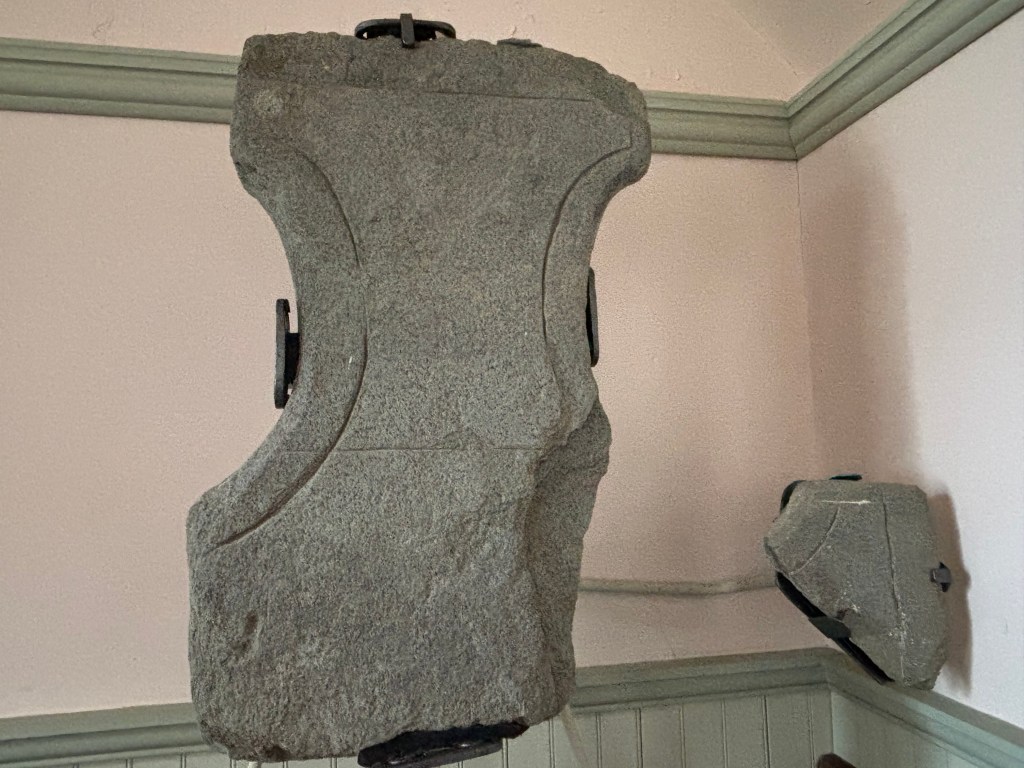
    Fragments of this remarkable free-standing stone cross were discovered in Inchnadamph churchyard in 1993, where they had been reused as a grave marker.

    Reconstruction cross

    When complete, the cross is thought to have stood about three metres tall. It has been dated broadly to between the 8th and 11th centuries, making it by far the most northerly known cross of its kind on the Scottish mainland.

    The cross was carved from a grey-green metabasic rock originating in the south-west Highlands—an area well known for its carved crosses. We do not know whether the stone was brought to Inchnadamph as an unworked block and carved locally, or whether the finished cross was transported here. Either journey would have required considerable effort.

    Its overall shape has similarities with crosses from the south-west, including the Kilnave Cross on Islay. Its decoration, however, is much more unusual: a simple chamfer and incised border which has no known parallel in the Highlands. This distinctive style may reflect Scandinavian or Anglo-Scandinavian influence.

    The cross probably marked a sacred place used for outdoor worship, with a simple church later built nearby. A roughly circular enclosure survives in low-lying ground a few metres south-west of the churchyard. It may be prehistoric in origin, although places like this were sometimes reused by early Christian missionaries.

    These surviving fragments take the story of worship at Inchnadamph back many centuries before the present church—and leave us with some fascinating unanswered questions. Who commissioned and carved the cross? Was it made locally or carried into Assynt? And what did Inchnadamph mean to the people who gathered beneath it more than a thousand years ago?

  • MacLeod of Assynt Family Tree

    MacLeod of Assynt Family Tree

    For several centuries the MacLeods of Assynt were one of the principal families shaping the history of Assynt. Their story is closely connected with Ardvreck Castle, built by the family in the 16th century, and with the wider political and social history of the area.

    This family tree traces the MacLeods of Assynt from the medieval period through the generations associated with Ardvreck, showing marriages, succession and connections with other Highland families.

  • Ardvrecks Golf Course

    Ardvrecks Golf Course

    Loch Assynt Golf Course

    Just before the First World War, a nine-hole golf course was laid out in the area between the ruins of Ardvreck Castle and Calda House.

    It was designed by Eric Chaplin, the Duke of Sutherland’s grandson, and maintained by James MacKenzie of Inchnadamph with his grass-cutting machine and roller, both pulled by a pony. He also issued tickets to golfers and collected their fees, which were fixed at one shilling per day.

    Chaplin’s guests from Loch Assynt Lodge would often arrive at the course on a steam launch and remnants of the jetty where it moored can still be seen near the castle.

    Looking closely in the landscape you can still see the remains of one of the greens, across the road.

    At a recent roadshow we heard tell of a 9 hole course at Stoer Green. If anyone has any more information about this, we’d love to hear from you!