

At the historic heart of Assynt
At Inchnadamph, close to the head of Loch Assynt, stands the Old Parish Kirk of Assynt.
The present building belongs principally to the eighteenth century, but the religious history of this place reaches much further back. Medieval church records, an early carved stone cross, the MacLeod burial vault and generations of burials all point to Inchnadamph’s long importance as a place of worship and remembrance.
For centuries the kirk served a parish spread across a vast Highland landscape. Today it has another life: preserved as a historic building and home to the Historic Assynt Community Archive.
The Old Kirk at a glance
Place: Inchnadamph
Site type: Parish church and burial ground
Present building: 1740s
Earlier church: Established by the medieval period
Historic Assynt Hidden Lives Project: HLP 144
Associated site: MacLeod burial vault
Present use: Historic Assynt Community Archive
A much older church site
Although the surviving kirk is eighteenth century, Christianity at Inchnadamph has much earlier roots.
Assynt’s Hidden Lives notes that the original parish church at Inchnadamph was founded before 1274, making this one of the most important identifiable medieval ecclesiastical sites in the parish.
The church therefore belongs to a religious landscape that existed long before the present building, long before Calda House and perhaps before the earliest surviving parts of Ardvreck Castle.
The medieval kirk would have served a dispersed population across Assynt, linking communities scattered around the lochs, glens and coast through a shared parish structure.

The Inchnadamph Cross
One of the most remarkable clues to the early history of the site was found in the churchyard.
In 1993, fragments of an unusual carved cross were discovered here. This is an early historic cross, possibly influenced by Anglo-Scandinavian styles. Its precise archaeological context remains uncertain, but it demonstrates that the ecclesiastical history of Inchnadamph may reach considerably deeper into the early medieval period.
Historic Assynt’s own archaeological records broadly date the cross to around AD 800–1100.
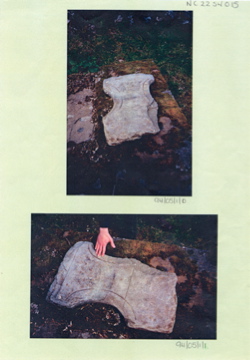

A fragment from an earlier Assynt
The cross raises as many questions as it answers.
- Who commissioned it?
- Where did it originally stand?
- Was it connected with an earlier church on the same site?
We may not yet know, but the fragments remind us that the eighteenth-century kirk is only the latest visible chapter in a much longer sacred landscape.
The parish kirk
The present church was built in the 1740s, replacing the earlier place of worship.
Its construction came during a period of major change in Assynt. Calda House had recently been destroyed, estate ownership was changing, and the social and political world around Loch Assynt was being reshaped.
Yet the parish kirk remained a central institution.
The building is modest in scale compared with Ardvreck or Calda, but its importance to local life was arguably much greater. For generations, people came here for worship, baptisms, marriages and funerals.

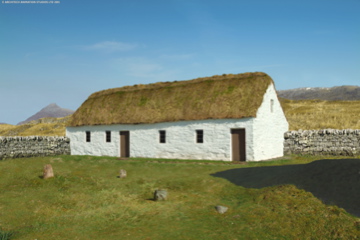
The present building dates principally from the eighteenth century, although the site has a much longer religious history.
Reading the building
The surviving kirk is a simple rectangular building, approximately 15 metres long and 6 metres wide, aligned east–west.
The exterior is whitewashed and pebble-dashed, with gable ends rising to around 7.5 metres. The main entrance is in the south wall, with four windows on the south side and two on the north. A small spire stands at the west end.
The simplicity of the building is characteristic of many post-Reformation parish churches in the Highlands.
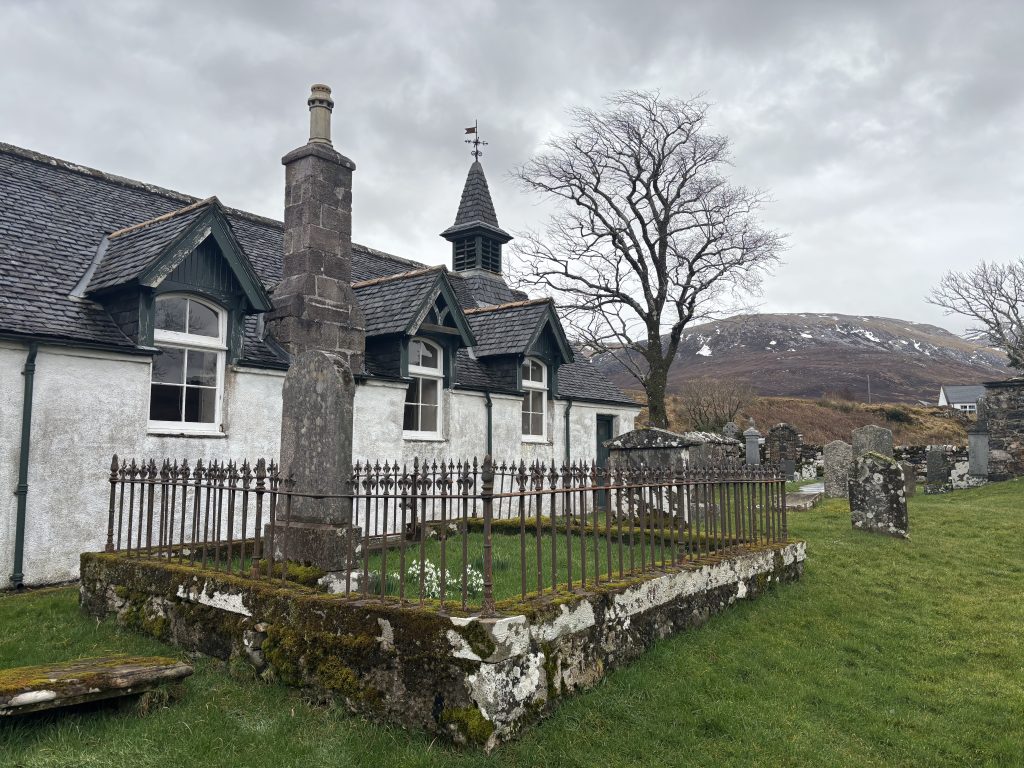
Look closely
When visiting, look for:
- the east–west alignment;
- the simple rectangular plan;
- the west-end spire;
- the pattern of windows and doors;
- evidence of later alterations;
- the relationship between the kirk and surrounding burial ground.
Worship in a scattered parish
Assynt was — and remains — a large parish.
The congregation served by Inchnadamph was spread across a difficult landscape of mountains, moorland, lochs and coast. Reaching church could involve a substantial journey.
That makes the kirk part of a wider story about how communities were connected before modern roads and transport.
John Home’s 1774 estate survey shows the kirk, manse, roads, cultivated land and nearby buildings as part of a busy Inchnadamph landscape. The route shown on Home’s map differs significantly from the modern A835: the old road linked the manse, kirk and Calda more directly through the valley.

John Home’s estate map shows the kirk and manse within a landscape of cultivated ground, buildings, roads and shielings.
The ministers of Assynt
Ministers, families and parish life
The ministers of Assynt were important figures within the community. Their work extended beyond Sunday worship into education, poor relief, estate relations and the everyday administration of the parish.
The Kirk had a succession of ministers whose lives reflect changing religious and social conditions in Assynt.

The church and the community
The kirk was never only a building. It was part of the rhythm of life in Assynt.
Baptisms marked entry into the community. Marriages joined families. Funerals brought people back to Inchnadamph from settlements across the parish.
The churchyard around the building preserves this history in stone.
Its memorials record generations of local families, ministers, estate figures and others associated with Assynt.

The MacLeod Vault
Within the churchyard stands the burial vault of the MacLeods of Assynt.
Its presence ties Inchnadamph directly to the history of Ardvreck Castle.
The MacLeods’ political centre was at Ardvreck, but members of the family were buried and remembered at the parish church.
Historic Assynt’s archaeological records broadly date the surviving vault to around 1600.
The churchyard
The churchyard is itself an important historic site. I has an enclosed burial ground approximately 32m by 26m, surrounded by stone walls.
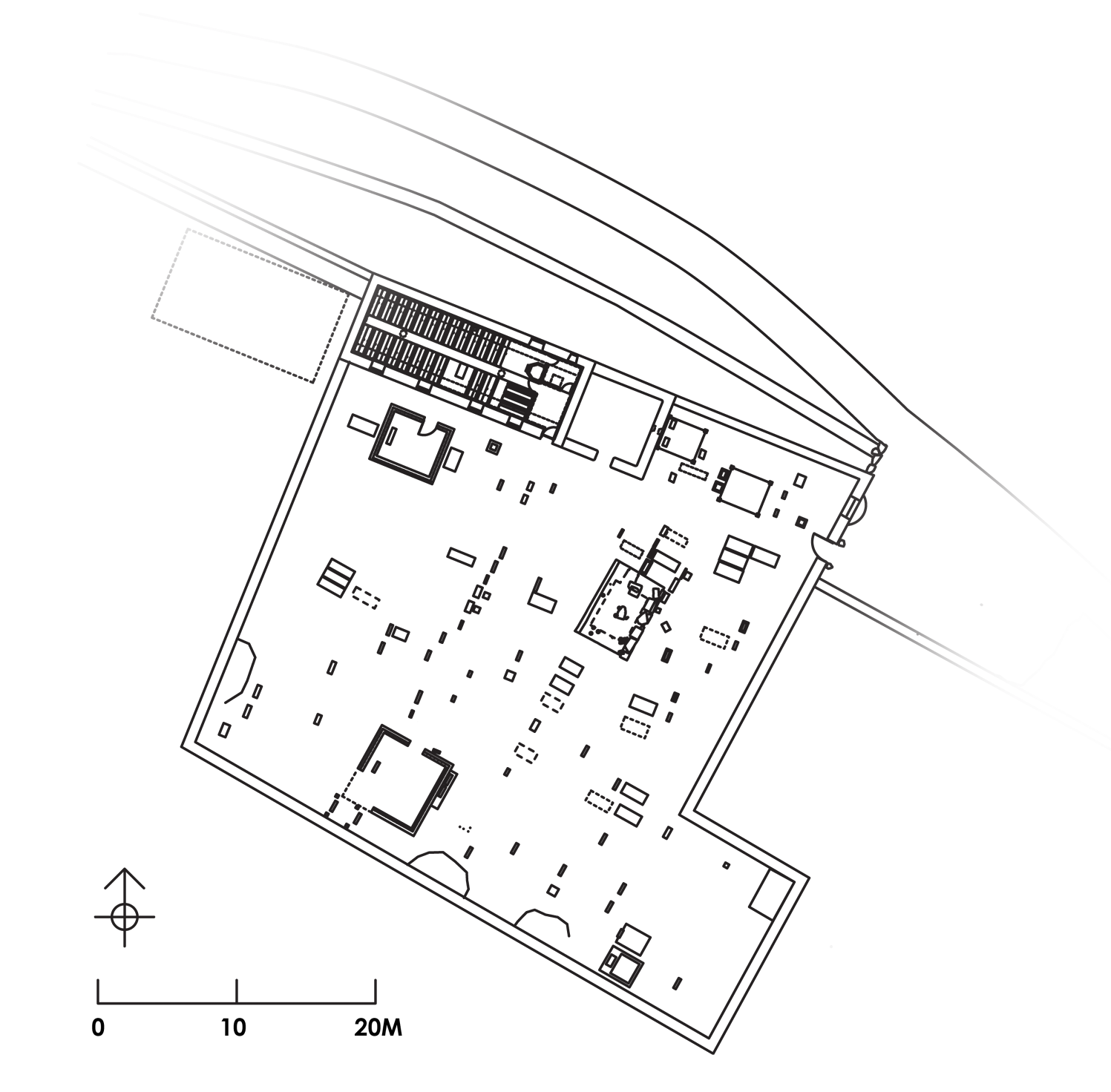
It contains monuments spanning different periods and social groups, from the MacLeod burial vault to later parish memorials.
At the west corner of the enclosing wall is also a Royal Air Force commemorative monument, showing how new layers of memory continued to be added to this older sacred landscape.
Inchnadamph as a parish centre
The kirk did not stand alone. Nearby were the manse, agricultural land, roads, houses and other buildings associated with the parish community.
Inchnadamph is a long-lived focus of settlement and agriculture, with archaeology ranging from Neolithic chambered cairns to modern monuments within a comparatively small area.
So the Old Kirk sits within one of the richest archaeological landscapes in Assynt.
Change and decline
Over time, changing patterns of population and worship altered the role of the kirk.
The building eventually ceased to function as Assynt’s principal parish church, with the centre of regular worship moving to Lochinver.
That could easily have left the Old Kirk without a future. Instead, concern over its deteriorating condition became one of the events that led directly to the formation of Historic Assynt.
Saving the Old Kirk
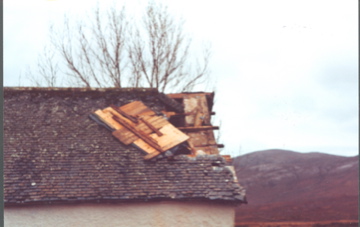
By the 1990s the redundant Old Parish Kirk was becoming ruinous.
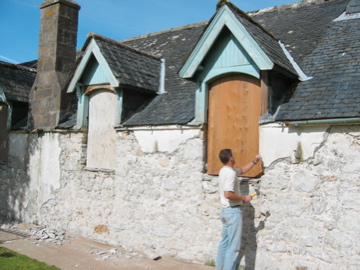
Local concern led to proposals for its conservation, alongside work at Ardvreck Castle and Calda House. This Inchnadamph project became the focus around which Historic Assynt developed as an independent organisation.
The conservation of the Old Kirk, Ardvreck and Calda had been completed by 2006, followed by work to the churchyard walls and the MacLeod burial vault.

From parish kirk to community archive
Following conservation, the building became home to the Historic Assynt Community Archive.
Today the archive brings together material relating to Assynt’s people, places and archaeology — photographs, maps, estate papers, local publications and archaeological records.
So a building that once preserved the parish’s spiritual life now helps preserve its documentary memory.
The Old Kirk has had two lives at the heart of Assynt: first as the parish church, and now as a place where the history of the parish is collected, researched and shared.
Visit the Historic Assynt Archive
The Old Kirk houses Historic Assynt’s collection of local historical and archaeological material.
Search the collections → [under development]
Explore the Landscape
Ardvreck Castle
Explore the development of the castle.
Calda House
The eighteenth-century mansion built by the Mackenzies of Assynt.
The MacLeod Vault
Explore the burial place of the MacLeods of Assynt.